Energy saving professional company



|
HOME > Business > Introduction to Heat Pump
Introduction to Heat Pump
What is Heat Pump?
Outline of Heat Pump
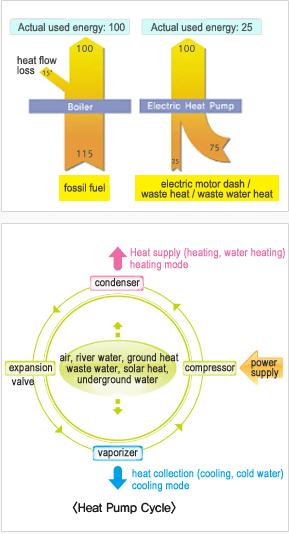
Heat pump absorbs heat from a low-temperature heat source (air, underground water, waste heat) and sends it back to a high-temperature heat source (indoor air or hot water) and is an energy-saving heat supply system to provide far more energy than power energy that is necessary for operations in the form of heat energy.
Principles of Heat Pump
This is concerns the production of cold water and hot water through water or air and a heat exchanger after producing high-temperature high-pressure and low-temperature low-pressure using features of refrigerant gas and a compressor in the process of transferring low-temperature heat and then transferring usable high-temperature heat.
Advantages of Heat Pump
1) Heat Pump is highly energy-saving because it uses waste heat
and natural energy.
2) With just one heat source equipment, cooling, heating and water-
heating are available.
3) Easy to repair and inexpensive maintenance and management
costs.
4) A convenient system which can be operated automatically without
an operator
5) Environmentally-friendly systems
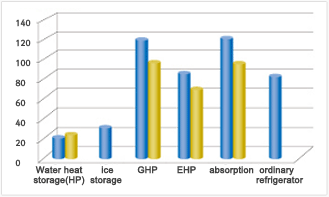
Comparison of operation costs
Heat pump absorbs heat from a low-temperature heat source (air, underground water, waste heat) and sends it back to a high-temperature heat source (indoor air or hot water) and is an energy-saving heat supply system to provide far more energy than power energy that is necessary for operations in the form of heat energy.
Principles of Heat Pump
This is concerns the production of cold water and hot water through water or air and a heat exchanger after producing high-temperature high-pressure and low-temperature low-pressure using features of refrigerant gas and a compressor in the process of transferring low-temperature heat and then transferring usable high-temperature heat.
Advantages of Heat Pump
1) Heat Pump is highly energy-saving because it uses waste heat
and natural energy.
2) With just one heat source equipment, cooling, heating and water-
heating are available.
3) Easy to repair and inexpensive maintenance and management
costs.
4) A convenient system which can be operated automatically without
an operator
5) Environmentally-friendly systems
Comparison of operation costs
Application
Large cooling and heating system
Factories, farms, department stores, large discount stores, training institutes, hotels, others
Medium-sized cooling and heating system
Churches, kindergartens, hospitals, wedding halls, restaurants, terminals, offices, others
Other cooling and heating system
Saunas, ski resorts, spas, golf courses, government offices, vinyl houses, others
Large cooling and heating system
Factories, farms, department stores, large discount stores, training institutes, hotels, others
Medium-sized cooling and heating system
Churches, kindergartens, hospitals, wedding halls, restaurants, terminals, offices, others
Other cooling and heating system
Saunas, ski resorts, spas, golf courses, government offices, vinyl houses, others
Heat Pump system
Principles of Heat Pump
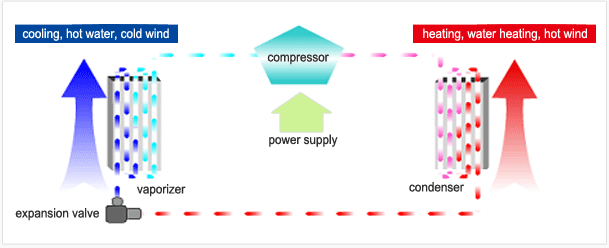
- Vaporization happens as a vaporizer absorbs heat from outside.
- A compressor draws in the low temperature, high-pressure gas.
- As the refrigerant is compressed in the compressor, the high-temperature, high-pressure gas is conveyed to the condenser.
- The refrigerant becomes liquid as the condenser discharges heat (hot wind, hot water).
- The high-pressure liquefied refrigerant is decompressed at the expansion valve.
- The low-temperature, low-pressure liquefied refrigerant recycles as it enters into the vaporizer.
Main application
Can be applied to almost all places related to living, such as cooling and heating systems of buildings, industrial processes, stock-raising industry, fish-raising industry and agriculture.
1. Facilities needing cold and hot water at the same time
2. Facilities using industrial waste heat (such as industrial facilities, etc)
3. Buildings with serious load changes (such as department stores, training institutes and churches, etc)
4. Facilities additionaly needing heat source systems
5. Cooling and heating systems of buildings affected by the law about the efficient use of energy
 About Us
- CEO’s Message l History l Organization l Certificates l Location Map
- Business
- Business l Introduction to Heat Pump
- Products
- Water Source Heat Pump
- Waste Water Source Heat Pump ((IWM-12B series) l Waste Water Source Heat Pump (IWH-12A series) l
- Waste Water Source Heat Pump (IWB-12BA series) l Waste Water Source Heat Pump (IWK-12C series) - Sea Water Source Heat Pump
- Sea Water Source Heat Pump (IWS-55A, 53A, 13A series) l Sea Water Source Heat Pump (IWSK-55C, 53C series) - Air Source Heat Pump
- Air Source Heat Pump (IAW-16A series) l Air Source Heat Pump (IACH-16B, IACHK-16C series)
- Air Source Heat Pump (IAT-16A-010, IAH-16A-05) - Ground Source Heat Pump (IGH-11A, 11B series) / Food Dryer (IAD-66A series) / Cooler

126-6 Sincheon-ri, Hallim-myeon, Gimhae City, Gyeongsangnam-do, Korea
Tel : 82-55-724-1112 | Fax : 82-55-345-1744 | E-mail : jaja1009@iljin-mac.com
COPYRIGHT 2012 Iljin E-Plus . ALL RIGHTS RESERVED.
COPYRIGHT 2012 Iljin E-Plus . ALL RIGHTS RESERVED.
